
Bursitis
Bursitis Treatment in Sydney
Get expert physiotherapy for bursitis of the shoulder, hip, knee or foot at any of our eight clinics across Sydney. Our physiotherapists target the cause of your pain, not just the symptoms, with hands-on care and a tailored exercise programme. Medicare and NDIS funding accepted.
Expert Physiotherapy for Bursitis
Bursitis is one of the most commonly diagnosed sources of joint pain, and many people are offered medications or a corticosteroid injection as a first option.
Both can help in the short term, but neither addresses why the bursa became inflamed in the first place.
At iPhysio Australia, our bursitis treatment in Sydney is built around finding and correcting the underlying cause: the movement patterns, muscle imbalances and daily habits that keep irritating the bursa.
Our physiotherapists combine evidence-based, hands-on care with a tailored exercise programme to settle the current flare and reduce the chance of it returning. Care is non-invasive, with no surgery and no injections.
What is Bursitis?
Bursae are small, fluid-filled sacs that act as cushions between your bones, tendons and muscles, helping joints move smoothly.
When a bursa becomes inflamed or irritated, usually from overuse, repetitive pressure or a direct knock, it can swell and cause pain, stiffness and tenderness.
This is bursitis. It most often affects the shoulder, hip, knee and foot, though it can occur in almost any joint.
Common Causes of Bursitis
Bursitis usually develops when a bursa is irritated over time rather than from a single injury. The most common causes we see include:
- Repetitive movement, especially overhead motions, running, kneeling or repeated lifting
- Sustained pressure on a joint, such as prolonged kneeling, leaning on elbows, or sitting on hard surfaces
- Direct trauma or a fall onto the joint
- Poor posture or movement patterns that overload the bursa during daily activity
- Age-related changes in the tissues around joints
- Underlying conditions such as arthritis, gout or rheumatoid disease
Symptoms and When to See a Physiotherapist
Bursitis symptoms vary by location and severity, but most people notice some combination of:
- Pain that worsens with movement or pressure on the joint
- Swelling or visible puffiness over the affected area
- Tenderness when the joint is touched
- Warmth or mild redness
- Reduced range of movement in the joint
Seeing a physiotherapist early is worthwhile, as prompt treatment often shortens recovery and reduces the chance of the bursitis becoming chronic. Rapid swelling combined with significant redness, heat or fever can indicate septic bursitis, a bacterial infection of the bursa. This needs urgent medical attention rather than physiotherapy, so see a GP or go to an emergency department straight away.
Bursitis by Body Part
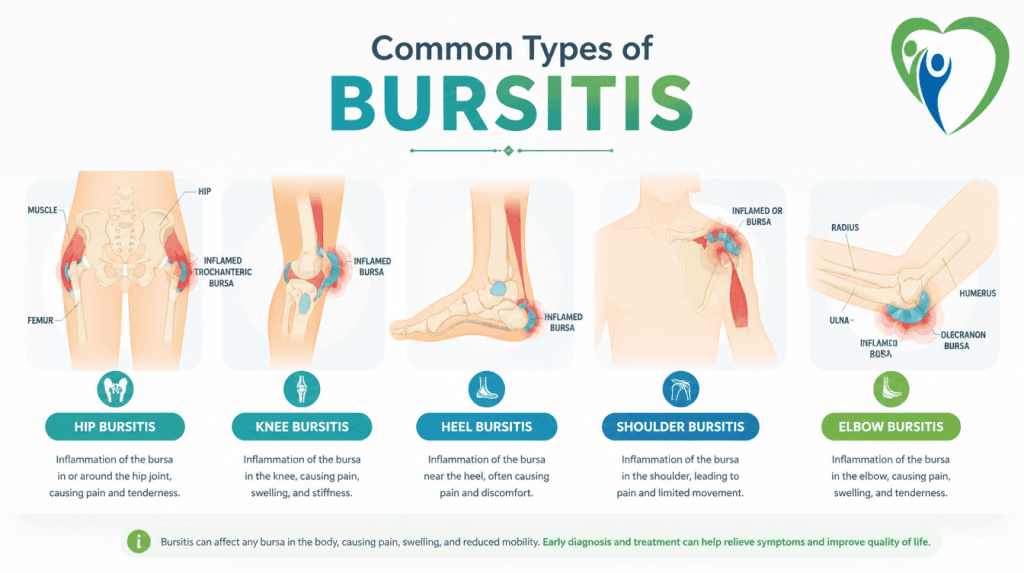
Bursitis can affect any joint, but four areas are by far the most common. For each, the same principles of physiotherapy apply: identify what is irritating the bursa, settle the inflammation, and rebuild the movement patterns that protect the joint long term.
Shoulder Bursitis
(Subacromial Bursitis)
Shoulder bursitis often develops from repeated overhead movement in sport, work or daily tasks. Current evidence shows it frequently co-exists with rotator cuff tendinopathy, so a good assessment looks for both rather than treating bursitis in isolation.
For full treatment of shoulder conditions, including bursitis, see our Shoulder Pain page.
Hip Bursitis
(Trochanteric Bursitis)
Hip bursitis typically causes pain and tenderness on the outside of the hip that can radiate down the thigh. It is common in runners, walkers and people who sleep on their side, and often flares with prolonged sitting or stairs.
For full treatment of hip conditions, including bursitis, see our Hip Pain page.
Knee Bursitis
(Prepatellar Bursitis)
Knee bursitis is most often caused by prolonged kneeling, which has earned it the nickname “housemaid’s knee”. It usually presents as visible swelling at the front of the kneecap with pain on kneeling, bending or pressure.
For full treatment of knee conditions, including bursitis, see our Knee Pain page.
Foot and Ankle Bursitis
Bursitis around the foot and ankle is less common but very real, particularly retrocalcaneal bursitis at the back of the heel where the Achilles tendon meets the heel bone. It often appears with overuse, ill-fitting footwear or sudden increases in activity.
For full treatment of foot and ankle conditions, including bursitis, see our Foot and Ankle Pain page.
How Our Physiotherapists Treat Bursitis
Effective bursitis treatment starts with understanding exactly what is irritating the bursa, then layering the right care to settle it and stop it returning.
Our physiotherapists carry out a thorough assessment of your joint, your movement, your daily activities and your history, and then build a treatment plan around the approaches below.
Comprehensive Assessment
A detailed evaluation to identify the source of bursitis and rule out related conditions like rotator cuff tendinopathy, so treatment targets the real cause.
Manual Therapy and Joint Mobilisation
Hands-on techniques to relieve pressure on the bursa and restore comfortable movement in the affected joint.
Dry Needling and Soft Tissue Therapy
Targeted techniques to release the surrounding muscles that contribute to bursa irritation.
Tailored Exercise Programme
A progressive plan to correct movement patterns and strengthen the muscles around the joint, preventing recurrence.
Education and Activity Modification
Practical guidance on the daily habits and movements that aggravate bursitis, so you can manage it long term.
Bursitis Treatment Across Our 8 Sydney Clinics
You can access expert bursitis physiotherapy at any of our eight clinics across Sydney. Choose the clinic most convenient for you:
T: 02 9718 1906
E:
Location
255 Burwood Road, Belmore, NSW 2192
Operating Hours
Monday – Friday: 8am – 6pm
Saturday: 8am – 12pm
T: 0423 078 384
E:
Location
26 Bridge Rd (Canterbury Leagues)
Belmore, NSW 2192
Operating Hours
Monday – Friday: 8am – 7pm
Saturday: 8am – 12pm
T: 02 8765 1300
E:
Location
Level 1, 63 Majors Bay Road
Concord, NSW 2137
Operating Hours
Monday – Friday: 8.30am – 7pm
Saturday: 9am – 1pm
T: 0429 928 811
E:
Location
Room 5, 213-219 Darlinghurst Rd
Darlinghurst, NSW 2010
Operating Hours
Monday – Friday: 8am – 6pm
T: 02 8608 1148
E:
Location
Shop 1, 180 Pitt St
Merrylands, NSW 2160
Operating Hours
Monday – Friday: 8am – 7pm
Saturday: 8am – 2pm
T: 02 9739 6783
E: reception@iphysioaustralia.com.au
Location
8 – 10 Edwin St (inside the gym)
Mortlake, NSW 2137
Operating Hours
Monday – Friday: 8am – 7pm
Saturday: 8am – 2pm
T: 02 9798 8790
E:
Location
1 Hardie Ave
Summer Hill NSW 2130
Operating Hours
Monday – Friday: 8am – 7pm
Saturday: 8am – 2pm
T: 02 7820 9202
E:
Location
Level 1, Shop 1,
6 Gauthorpe St,
Rhodes NSW 2138
Operating Hours
Monday – Friday: 8am – 7pm
Saturday: 8am – 12pm
Don't let bursitis hold you back.
Book an assessment with iPhysio Australia and take the first step towards lasting relief, at any of our eight Sydney clinics..
Frequently Asked Questions
What is bursitis?
Bursitis is inflammation of a bursa, one of the small fluid-filled sacs that cushion your joints. When a bursa becomes irritated, usually through overuse, repetitive pressure or a direct knock, it can swell and cause pain, tenderness and reduced movement in the affected joint.
What causes bursitis?
Most bursitis develops from repetitive movement, sustained pressure on a joint, poor movement patterns or a direct injury. Age-related changes and conditions such as arthritis or gout can also contribute. Identifying the specific cause is central to effective treatment.
What are the symptoms of bursitis?
Common symptoms include pain that worsens with movement or pressure, swelling, tenderness, warmth around the joint and reduced range of movement. Symptoms vary by location, but most people notice some combination of these.
Can physiotherapy treat bursitis?
Yes. Physiotherapy is one of the most effective treatments for bursitis because it addresses the underlying cause of bursa irritation, not just the symptoms. Hands-on techniques, targeted exercises and education form the core of treatment.
What is the difference between bursitis and tendonitis?
Bursitis affects the fluid-filled bursa, while tendonitis affects a tendon. They often produce similar symptoms and frequently co-exist around the same joint, particularly in the shoulder. A physiotherapy assessment can identify which is contributing to your pain.
How long does it take to recover from bursitis?
Mild bursitis can settle within a few weeks with the right care, while longer-standing or chronic bursitis may take several months. Your physiotherapist will give you a clearer timeframe based on your assessment.
Is surgery necessary for bursitis?
For the vast majority of people, no. Most bursitis responds well to physiotherapy and other conservative care. Surgery is reserved for a small number of cases that do not improve with non-surgical treatment.
Should I use ice or heat for bursitis?
Ice is generally recommended in the first few days while the bursa is acutely inflamed, applied for short periods at a time. Heat can be useful later for tight surrounding muscles. Your physiotherapist can advise based on your specific case.
Which iPhysio clinics treat bursitis?
All eight of our Sydney clinics treat bursitis: Rhodes, Darlinghurst, Summer Hill, Concord, Belmore, Merrylands, Mortlake and C-Life Gym. Choose whichever location is most convenient for you.